
One of our estimates listed $850 in labor to install and grout a standard mosaic on a shower floor. The homeowner later chose a star-and-cross pattern and wanted it to continue from the bathroom into the shower. The square footage hadn’t changed. The installer now had to line up the pattern at the entrance, carry it across the sloped floor and fit the pieces around the drain. That added $850 in labor. The revised shower-floor line came to $1,700.
We originally showed the base price and the upgrade in different parts of the payment breakdown. The homeowner had a fair question: which figure was the final price? It was much clearer with three numbers on one line: original labor $850, change +$850, revised labor $1,700. Those figures belong to that project. What you can use on yours is the way the change is shown.
What’s included in a “Schluter shower”?
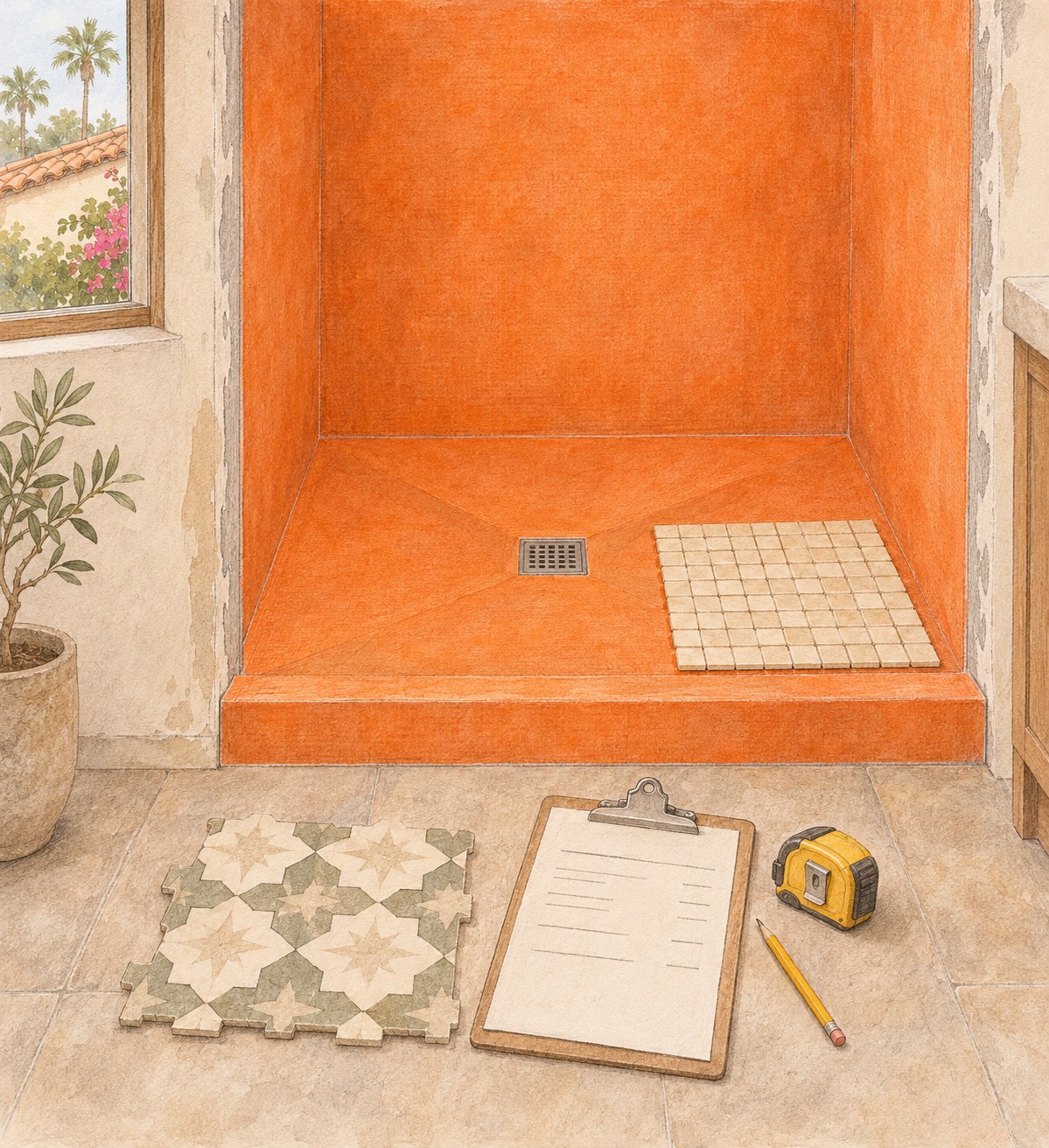
We typically build a tiled shower floor over a Schluter tray. You choose the tile you’ll stand on. Underneath are the sloped base, waterproofing and drain. A bid that says “Schluter shower pan” leaves a basic question open: does the price cover installing the tray, or does it also cover setting and grouting the mosaic over it? If there’s a curb, does the tile price cover the top and both faces?
For a point-drain shower, I’d want to see the selected Schluter KERDI-SHOWER tray and size, the KERDI-DRAIN model and the grate. Is the drain staying where it is? What work on the existing floor is included? The estimate should describe the tray installation, curb or curbless entry, pan flood test before tile, and finish tile installation. If you later move the drain or ask for a flush entry, you can see which parts of the original scope need revisiting.
Which “waterproof board” will actually arrive?
Ask for the manufacturer, product name and wall coverage. For instance: Schluter KERDI-BOARD on three walls to the agreed height, with the system materials for treating joints and fasteners. If the proposal specifies Johns Manville GoBoard, it should name that board and the selected joint and fastener treatment. If “Schluter” refers only to the floor, the wall product deserves its own line. Two finished showers can have the same tile and different materials behind it.
Show the installer your niche and the exposed end of the wall before placing the tile order. Ask for the niche dimensions, shelf material and exposed-edge finish in writing. “Niche included” might cover a standard prefab insert. A full-width niche with a stone shelf and mitered corners takes different work. If those details are what you like in your inspiration photo, make sure they made it into the price.
What is fixed labor, and what will you still have to buy?
In our estimates, I separate labor from purchases. We can assemble a supplier order for the homeowner to pay directly. When we make purchases, we reconcile them to supplier receipts. An estimate for materials is still an estimate until the purchases are made. Separate installation supplies from finish selections such as tile, valve trim, drain grate and glass. “Install shower trim” may cover labor while the trim kit itself is yours to buy.
On a separate repair, the homeowner decided to rebuild the entire curb and keep the existing glass enclosure. We added $650 in labor to remove, rebuild and tile the curb, and $1,100 to carefully remove and reinstall the glass. Previously quoted labor of $3,700 became $5,450. Estimated installation materials were another $1,090, to be reconciled against receipts. The estimated total for that scope was $6,540. This was a repair with reused glass. The figures illustrate why “glass included” needs a verb and why a materials estimate should be labeled before you compare two totals.
What if demolition reveals more work?
Suppose the crew finds a damaged patch of wood subfloor under the old tile. Before demolition, it can be hard to know how far the damage extends. The original bid can still say what routine prep is included and what finding will trigger a conversation about additional work.
Ask for a photo showing the extent of the damage, the prep already in the base bid, and the extra labor and materials to replace the damaged section. Ask what it does to the schedule and approve the written change before that extra work starts. Use the same approach when you change a finish: what comes out of the original scope, what goes in, and what’s the net difference? That’s how you keep the original prep from being counted twice.
A five-minute way to compare the bids on your kitchen table
Write down six items: demolition and haul-away, substrate prep, wall and pan system with flood test, tile and edge finishes, plumbing, and glass. Next to each item on each bid, write “labor included,” “I supply it,” “estimated allowance” or “please clarify.” Leave an empty line as a question. Give both bidders a chance to fill it in before you compare the totals.
Keep the dated estimate, supplier orders and receipts. After demolition, add any approved changes. Before tile, save photos of the installed waterproofing and the pan test result. When the final bill arrives, each changed line should show the original price, the addition or credit and the revised price. Payments already made belong on a separate line so you can see the balance due.
Here’s a message to copy: “Could you break down the shower price for my selections? Please list the wall, tray and drain products, the tile layout and edge finish you priced, what I’m purchasing separately, and how we’ll approve changes after demolition. Please mark any figures that are still allowances.”
Have two bids in hand? Compare your contractor estimates.
Planning the work? Explore shower repair and replacement.
Mikhail Belov · Mi Tile Installation Experts · Greater Sacramento
Technical references: Schluter Shower System Installation Handbook · Schluter shower water test · Johns Manville GoBoard